
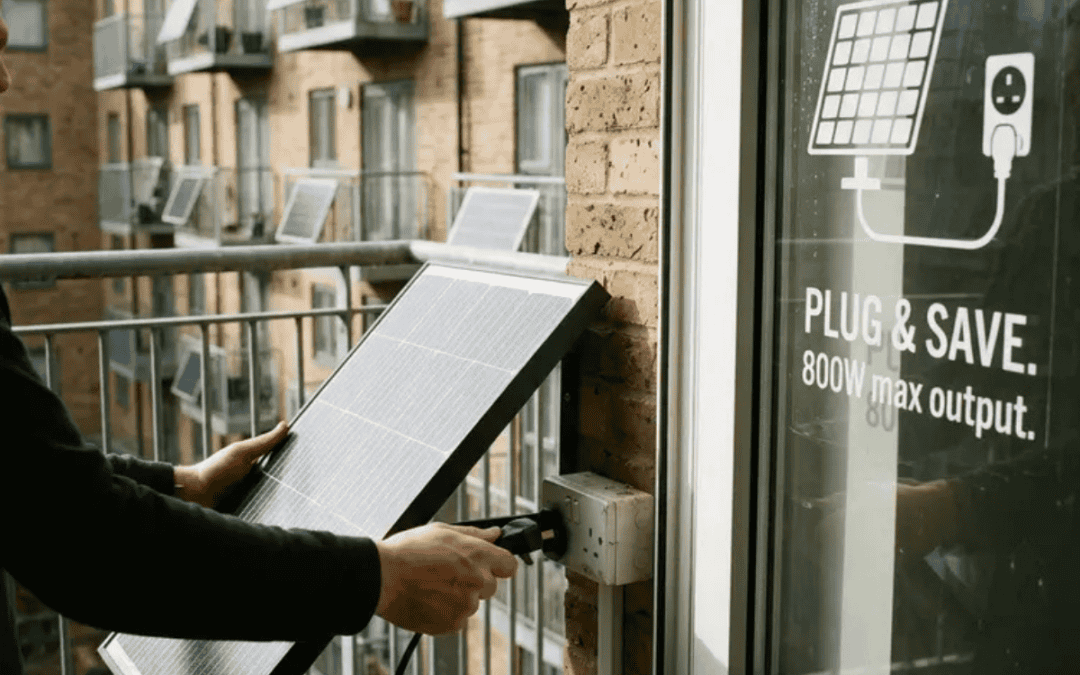
I’ve been tracking energy policy long enough to recognize when something shifts from theoretical to inevitable. The UK government’s announcement that plug-in solar panels will hit retail shelves within months falls squarely in that category.
This isn’t another incremental solar subsidy program or a tax credit buried in policy documents. This is the government saying you can walk into a store, buy a solar panel, plug it into your wall outlet, and start generating electricity. No installer. No permits. No £10,000 investment.
The implications extend far beyond individual households saving money on electricity bills.
The Accessibility Problem Traditional Solar Never Solved
Traditional rooftop solar installations created an invisible barrier. You needed to own your home. You needed a suitable roof. You needed capital or access to financing. You needed to navigate planning permissions in some cases.
That excluded renters entirely. It excluded apartment dwellers. It excluded anyone without several thousand pounds available for upfront investment.
The result? Solar adoption is concentrated among homeowners with disposable income and suitable properties. The energy transition became another system where those with resources gained access to savings and sustainability, while everyone else remained locked into whatever their utility provider offered.
Approximately 285,000 flats with balconies exist in England alone whose residents could benefit from plug-in solar rule changes, according to recent analysis. That’s a quarter million households previously excluded from renewable energy generation based purely on their housing situation.
Plug-in solar panels eliminate most of these barriers. You rent? You can take the panel with you when you move. You live in a flat? Mount it on your balcony. Don’t you have £10,000? These systems cost a fraction of traditional installations.
Europe Already Proved This Works at Scale
The UK isn’t experimenting here. Germany sees around half a million new plug-in solar devices installed per year, according to government estimates. Across Europe, 4-5 million plug-and-play solar systems already operate.
This is mainstream technology in comparable markets.
A typical 800-watt balcony solar system in central Europe costs between €300 and €600, with payback periods under three years. UK analysis suggests plug-in solar systems could save households approximately £1,100 over their 15-year lifespan.
The economics work. The technology works. The question was always regulatory, not technical.
The UK government’s removal of those regulatory barriers signals recognition that energy democratization serves both climate goals and household financial resilience. When global energy markets spike, households with their own generation capacity maintain more control over their costs.
The Bigger Picture: Three Simultaneous Shifts
The plug-in solar announcement didn’t happen in isolation. The government rolled out three interconnected initiatives that together reshape how the UK generates and consumes electricity.
First: plug-in solar accessibility. Retail availability means mass market distribution. When major retailers stock these panels alongside other home improvement products, the psychological barrier drops. Solar becomes a normal consumer purchase rather than a specialized installation project.
Second: mandatory solar and low-carbon heating in new construction. The Future Homes Standard requires most new homes in England to include solar panels and low-carbon heating systems as standard features. This creates a generational divide in housing stock efficiency that will affect property values and operating costs for decades.
The government estimates these standards could save families up to £830 per year on energy bills compared to standard homes with an EPC rating of C, while creating at least 75% less carbon emissions than homes built to 2013 standards.
Third: dynamic pricing tied to renewable generation. The government is introducing a system offering discounted electricity to households during periods of excess renewable generation, particularly in wind-heavy regions like Scotland and the East of England.
This addresses what I call the “wasted wind” problem.
The Wasted Wind Problem
In 2025, over 12 terawatt hours of renewable power were curtailed in the UK. That’s clean energy the grid couldn’t use, so wind turbines got paid to turn off.
The dynamic pricing system creates a market mechanism to absorb that excess generation. When wind production exceeds demand, prices drop. Households with smart meters can shift consumption to those periods and reduce their bills.
Between July 2020 and July 2021, Octopus Energy’s Agile tariff saw unit prices drop below 2p/kWh 163 times, demonstrating how renewable abundance can create negative pricing events that benefit consumers.
The system works both ways. Households that can shift consumption to low-price periods save money. The grid avoids wasting renewable generation. The economics align with environmental goals.
Add plug-in solar panels and battery storage into this mix, and you create households that can generate during the day, store excess, and consume during peak pricing periods. The home becomes an active participant in grid management rather than a passive consumption point.
What This Reveals About Infrastructure Strategy
I’ve noticed a pattern in how governments approach infrastructure challenges. The traditional response involves massive capital investment in centralized systems. Build bigger transmission lines. Expand grid capacity. Construct large-scale generation facilities.
That approach still matters. But the UK’s strategy shows recognition that behavioral incentives and distributed technology can complement infrastructure investment.
You can’t build transmission capacity fast enough to handle every renewable generation spike. But you can create price signals that encourage consumption during those spikes. You can enable households to generate and store their own power, reducing peak demand on the grid.
The combination proves more effective than either approach alone.
This principle extends beyond energy. When infrastructure limitations constrain system performance, technology that enables distributed participation can relieve pressure while infrastructure catches up. The key is creating frameworks where individual actions aggregate into system-level benefits.
The Market Response Tells You What’s Coming
Major retailers, technology manufacturers, and energy companies are already preparing for rollout. That level of private sector preparation suggests they see a significant market opportunity.
The balcony solar market in Europe is projected to grow from $500 million in 2025 to $1.8 billion by 2033, with a 15% annual growth rate.
When policy support aligns with a commercial opportunity, adoption accelerates faster than either force alone could achieve. The government removes regulatory barriers. Competition drives down prices and improves technology. Distribution channels expand. Marketing makes the technology visible to mainstream consumers.
We’ve seen this pattern with electric vehicles, heat pumps, and battery storage. The inflection point arrives when the technology becomes good enough, cheap enough, and easy enough that mass market adoption makes economic sense independent of environmental motivation.
Plug-in solar appears to be reaching that inflection point in the UK, following the path Germany and other European markets already traveled.
The Equity Dimension Nobody Talks About
Energy transitions tend to benefit early adopters who can afford the upfront investment. Those households lock in lower operating costs while everyone else continues paying market rates that subsidize grid infrastructure and fossil fuel volatility.
Making renewable energy accessible to renters and apartment dwellers addresses this equity gap directly. When the barriers to entry drop low enough, the benefits are distributed more broadly across income levels and housing situations.
This matters for the political sustainability of climate policy. If the energy transition consistently benefits homeowners while leaving renters behind, support fragments along housing tenure lines. When the transition includes pathways for everyone to participate and benefit, political coalitions strengthen.
The UK’s approach creates multiple entry points: plug-in panels for renters and flat dwellers, mandatory installations in new construction, and dynamic pricing for those with smart meters. Each addresses different barriers for different demographic segments.
What Happens When Homes Become Energy Hubs
The integration of solar panels, battery storage, electric vehicles, and heat pumps points toward homes functioning as energy hubs rather than passive consumption points.
You generate electricity during the day. Store excess in home batteries or your EV. Heat water when electricity is cheap. Run appliances during low-price periods. Feed surplus back to the grid during peak demand.
This transforms the relationship between households and utility providers. The utility becomes an energy services company managing bidirectional flows rather than a one-way supplier. Households become active grid participants with economic incentives to optimize consumption patterns.
The business model implications extend throughout the electricity sector. Traditional utilities built around selling kilowatt hours face declining revenues as households generate more of their own power. New service models emerge around energy management, optimization software, and grid services.
We’re in the early stages of this transition. But the direction is clear.
The Geopolitical Subtext
The government’s emphasis on energy security amid “ongoing global instability” reveals how climate policy and geopolitical strategy increasingly overlap.
Renewable energy serves dual purposes: environmental sustainability and strategic independence from volatile global commodity markets. When your energy comes from domestic wind, solar, and nuclear rather than imported gas and oil, you reduce exposure to supply disruptions and price manipulation.
This convergence accelerates policy implementation. Climate advocates and national security strategists arrive at similar conclusions through different reasoning. The coalition supporting renewable energy expands beyond environmental concerns to include energy security, economic stability, and strategic autonomy.
The UK’s approach demonstrates this thinking. Plug-in solar panels reduce household vulnerability to energy price spikes. Dynamic pricing absorbs domestic renewable generation that would otherwise be wasted. Mandatory installations in new construction lock in lower operating costs and emissions for decades.
Each initiative addresses both environmental and security objectives.
What to Watch
The real test comes in execution. Policy announcements matter less than implementation details, retail availability, consumer adoption rates, and grid integration challenges.
I’ll be watching several indicators:
Retail pricing and availability. Do these panels actually appear in stores at accessible price points? Which retailers stock them? How visible are they to mainstream consumers?
Installation simplicity. Does the plug-in process work as advertised? What technical issues emerge? How does the industry handle customer support and troubleshooting?
Grid integration. How do distribution network operators handle increasing numbers of small-scale generators? What technical challenges arise? How quickly do they adapt?
Adoption patterns. Who buys these panels first? Do they reach renters and flat dwellers as intended, or do early adopters follow traditional solar demographics?
Policy evolution. How do regulations adapt as adoption scales? What unforeseen issues require adjustment?
The gap between policy announcement and mass market reality often reveals where theoretical frameworks meet practical constraints. The UK’s success depends on navigating that gap effectively.
The Pattern Worth Recognizing
Plug-in solar panels represent a broader trend: the democratization of systems previously accessible only through significant capital investment or institutional relationships.
Personal computers decentralized computing. Smartphones democratized information access. Now accessible renewable energy technology is decentralizing power generation.
The pattern repeats when technology reaches a point where barriers to entry drop low enough that individual participation becomes economically rational. Centralized systems don’t disappear, but they face competition from distributed alternatives that offer different value propositions.
For energy systems, that value proposition includes control, resilience, cost savings, and reduced exposure to external volatility. For enough households, that combination justifies adoption independent of environmental motivation.
When individual incentives align with system-level benefits, change accelerates. The UK’s integrated approach creates those alignments across multiple dimensions: household economics, grid management, energy security, and emissions reduction.
Whether execution matches ambition remains to be seen. But the strategy recognizes something fundamental: infrastructure transitions succeed when they create pathways for broad participation rather than concentrating benefits among those who already have resources and access.
That principle extends well beyond energy policy.