
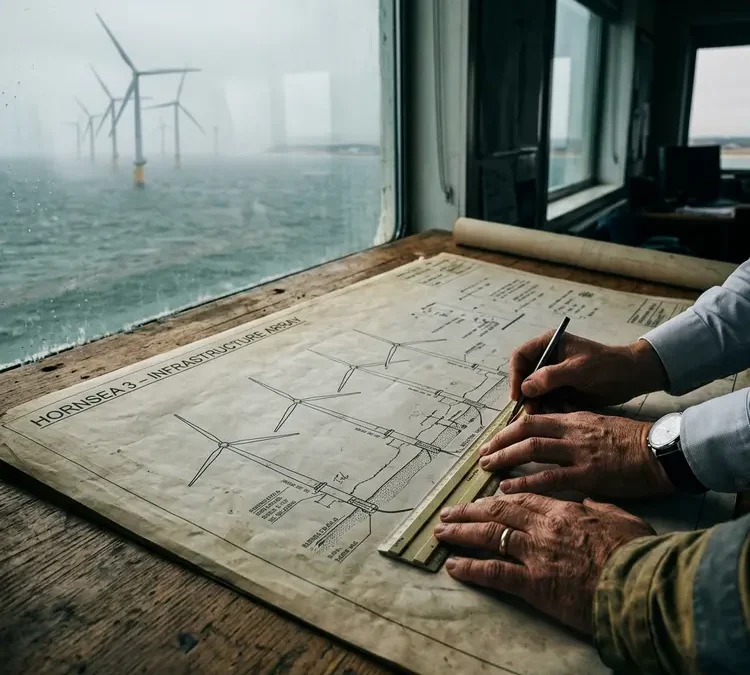
Mubadala just wrote a $325 million check for a wind farm off the coast of Norfolk.
The Abu Dhabi sovereign wealth fund joined Apollo, the USS pension scheme, and La Caisse in backing Hornsea 3, the world’s largest offshore wind project. When complete, this 2.9-gigawatt facility will power 3.3 million UK homes.
This isn’t a green initiative. It’s capital reallocation.
Sovereign wealth funds from oil-producing nations are moving billions into renewable infrastructure. Not because they’re abandoning fossil fuels, but because they’re reading market data.
The Numbers Behind It
Mubadala’s assets under management hit $385 billion at the end of 2025, with annual returns exceeding 10% on both five and ten-year investments.
These aren’t experimental bets. They’re core portfolio positions.
Gulf sovereign wealth funds deployed $82 billion in 2023 and $55 billion in the first nine months of 2024, accounting for nearly two-thirds of all sovereign wealth deployment globally.
This capital flow isn’t opportunistic. It’s systematic.
Annual clean energy investments need to reach $4.6 trillion by 2030 to hit net-zero emissions by 2050. That’s a financing gap that creates opportunity.
Institutional investors are positioning themselves to fill it.
How the Deal Structure Works
Apollo-managed funds acquired a 50% stake in Hornsea 3 from Orsted for $6.5 billion in late 2025. This transaction represents one of the largest renewable energy asset deals on record.
Orsted kept the other 50% and retained operational control.
This structure shows renewable energy development is splitting into two functions.
Technical developers who build and operate projects. Financial sponsors who provide capital.
The separation creates liquidity. Developers can recycle capital into new projects. Institutional investors get exposure to operational assets with predictable cash flows.
It’s the same model that scaled infrastructure investment in toll roads, airports, and telecommunications networks.
The Consortium Model as Risk Distribution
Mubadala didn’t write this check alone. The investor group includes:
- Apollo Funds (US private equity)
- USS pension scheme (UK institutional capital)
- La Caisse (Canadian institutional investor)
- Mubadala (Abu Dhabi sovereign wealth fund)
This multi-jurisdictional structure distributes risk while aggregating capital pools large enough to fund gigawatt-scale developments. It’s the blueprint for financing next-generation energy infrastructure.
When pension schemes co-invest alongside sovereign wealth funds in offshore wind projects, renewable infrastructure has crossed into institutional investment grade territory.
Conservative institutional capital doesn’t chase trends. It follows predictable long-term cash flows suitable for matching pension liabilities.
The Geographic Patterns
Hornsea 3 sits 120km off the Norfolk coast. It will use up to 231 units of SG 14-236 DD offshore wind turbines, each with 14MW capacity, installed across a 696km² area.
The project will support up to 5,000 jobs during construction and 1,200 permanent positions.
This is Orsted’s third major offshore wind development in the Hornsea area of the North Sea. Multiple gigawatt-scale projects are concentrating in a single region.
Renewable energy development benefits from clustering effects: shared infrastructure, regulatory familiarity, established supply chains, and concentrated technical expertise.
The UK is the largest offshore wind market outside China. The government set a target of 50GW of offshore wind capacity by 2030. Hornsea 3 represents 6% of this national target in a single project.
Private Equity as the Middleman
Apollo isn’t building wind turbines. They’re creating a secondary market for renewable energy assets.
Private equity firms are intermediaries in energy transition financing. They acquire stakes from developers, bring institutional capital, and provide liquidity that accelerates deployment.
The feedback loop:
Developers build projects. Private equity acquires operational assets. Developers use that capital to build more projects. Institutional investors get exposure to stable, cash-flowing infrastructure.
The average sustainable investment deal size reached $160.4 million in 2024, virtually identical to the $162.3 million average for non-sustainable deals.
Renewable infrastructure has achieved investment parity with conventional infrastructure.
Why Mubadala Bought Infrastructure and Software
Mubadala’s investment in Hornsea 3 came alongside their stake in Power Factors, a renewable energy management software provider, through a partnership with Vista Equity Partners.
Sophisticated investors are building vertical exposure across the renewable energy value chain, from physical infrastructure to the digital management platforms that run them.
The bet: energy transition is a multi-layered opportunity requiring exposure to both hard assets and the enabling technologies that optimize them.
When institutional capital moves into both infrastructure and software simultaneously, integrated thesis deployment is underway.
How Norway Recycles Fossil Fuel Wealth
Norway’s Government Pension Fund Global holds over $2.2 trillion, equal to 1.5% of all listed companies worldwide.
In 2025, the fund committed $1.5 billion to Brookfield’s Global Transition Fund II, buying exposure to solar, wind, and storage projects across continents.
This is how oil-producing nations recycle fossil fuel wealth into sustainable infrastructure.
Sovereign wealth funds from energy-exporting nations are using hydrocarbon revenues to build positions in renewable energy infrastructure.
They’re not abandoning their core business. They’re hedging against future market dynamics while generating returns from long-duration assets.
The De-Risking Function
Sovereign wealth funds absorb first-mover risks in commercially immature sectors. Their patient, long-horizon capital enables technology transfer, operational know-how, and manufacturing capability across borders.
By taking early positions, they de-risk the transition for private investors, accelerate project pipelines, and create investable ecosystems.
Sovereign wealth fund investments in renewable energies jumped from $3 billion in 2022 to $5 billion in 2023. Commitments to electric vehicles and battery technologies rose to $2.78 billion from negligible amounts the previous year.
This is capital reallocation at scale.
Scale Changes Everything
Hornsea 3’s 2.9GW capacity marks a fundamental shift from distributed generation to utility-scale renewable infrastructure.
Not rooftop solar or community wind projects. Primary energy infrastructure that replaces conventional power generation.
UK electricity demand will more than double by 2060, driven by structural shifts in transport, heating, and digital infrastructure. Hornsea 3 sits at the center of this buildout.
When renewable projects operate at this scale, they stop being alternative energy and become baseline power generation.
The Cross-Border Capital Flow
Capital is flowing from Abu Dhabi, through US private equity, into UK renewable infrastructure.
This geographic path illustrates the increasingly borderless nature of energy transition financing. Renewable energy investments are becoming standardized global assets, comparable to traditional infrastructure.
They’re transcending national energy security concerns that historically restricted cross-border energy infrastructure investment.
Middle Eastern funds like ADIA, PIF, and Mubadala are channeling billions into Mediterranean Europe and MENA neighbors, from renewable energy projects in Egypt to digital infrastructure in Italy.
A regional investment zone is forming.
Six Signals from the Hornsea 3 Deal
What the Hornsea 3 transaction reveals about where institutional capital is moving:
Renewable infrastructure has matured into institutional-grade assets. When conservative pension capital co-invests with sovereign wealth funds, it signals stable, predictable cash flows.
Scale creates investability. Gigawatt-scale projects attract multi-billion dollar institutional capital in ways that distributed generation never could.
The secondary market is forming. Private equity is creating liquidity for developers while providing institutional investors access to operational assets.
Vertical integration is the play. Smart money is moving into both physical infrastructure and the digital platforms that manage it.
Geographic clustering drives efficiency. Renewable energy development follows the same concentration patterns as other industries, creating regional hubs with shared infrastructure and expertise.
Cross-border capital flows are normalizing. Energy infrastructure is becoming a global asset class, with capital flowing across borders based on returns rather than national security concerns.
The Real Game
The Mubadala investment in Hornsea 3 isn’t about renewable energy. It’s about capital allocation and who understands where the next 30 years of infrastructure returns will come from.
Institutional investors are reading market signals that point to massive infrastructure buildout over the next three decades. They’re positioning to capture returns from that transition.
Oil-producing nations leading this capital deployment shows this isn’t ideology. It’s opportunity.
When sovereign wealth funds, pension schemes, private equity, and institutional investors converge on renewable infrastructure, a new asset class is forming.
The question isn’t whether renewable energy will scale. Capital allocation decisions answer that.
The question: who captures returns from building the infrastructure that powers the next economy?
Right now, that capital is flowing from Abu Dhabi to Norfolk, from Oslo to Brooklyn, from Toronto to Cairo.
This is the largest infrastructure financing shift since post-war highway construction.
The difference: this infrastructure generates electricity instead of burning it. And the capital allocators who built wealth from hydrocarbons are the ones building the system that replaces them.