
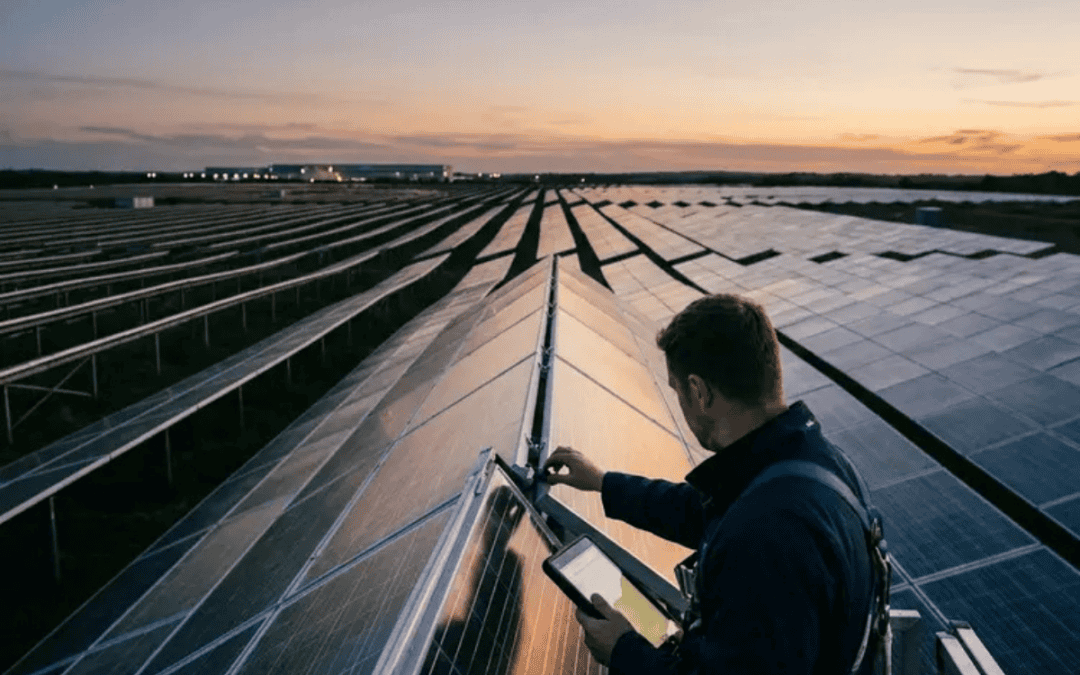
Cleve Hill Solar Park won IJGlobal’s 2025 “Solar Deal of the Year” award in July, but the recognition itself matters less than what the project represents: a 373 MW installation that supplied 0.7% of UK national power demand during peak commissioning.
Solar has crossed from alternative energy to critical national infrastructure.
At four times the size of the UK’s next biggest operational solar project, Cleve Hill powers 102,000 homes and cuts carbon emissions by 142,000 tonnes annually. During commissioning in May 2025, electricity exports peaked at 0.7 percent of national power demand, a threshold where single installations begin influencing energy security.
The Financing Innovation Nobody’s Talking About
IJGlobal awards recognize infrastructure finance innovation. Cleve Hill secured the largest solar and battery storage project financing ever undertaken in the UK, a record-breaking financing package combining contracted and index-linked revenues through state-backed instruments and private sector agreements.
The challenge: financing infrastructure with 25-year operational timelines when traditional project finance operates on shorter cycles. The solution: layering risk mitigation across multiple revenue streams.
Cleve Hill combined government support mechanisms with corporate power purchase agreements, creating a financing structure sophisticated enough to attract institutional capital at scale. Developer Quinbrook engineered a replicable financial product, the hidden achievement behind the physical installation.
How Corporate PPAs Became Load-Bearing Infrastructure
The financing structure depends on revenue certainty. Tesco’s long-term offtake agreement with Cleve Hill provides it, the largest solar corporate PPA executed in UK history.
Corporate power purchase agreements shifted from boutique sustainability arrangements to load-bearing components of project finance. Corporations with serious energy needs can anchor utility-scale renewable infrastructure. The PPA provides revenue certainty that makes the entire capital stack work.
Large corporations need credible decarbonization. Utility-scale solar needs creditworthy offtake partners. When these align, previously marginal projects become bankable. Renewable energy infrastructure integrates into corporate supply chains, not as sustainability theater, but as basic procurement.
From Alternative Energy to Nationally Significant Infrastructure
Cleve Hill’s financing innovation enabled another breakthrough: designation as the first solar and battery storage project consented as a Nationally Significant Infrastructure Project.
That classification changes regulatory pathways, planning processes, and how the project interfaces with national grid operations.
Solar used to sit in a different category from power plants and transmission lines. Cleve Hill’s designation means solar has graduated from supplementary generation to a foundational energy source.
The UK added 2.5 GW of new solar capacity in the first 11 months of 2025. Solar now contributes around 6.4% of the UK’s annual power generation. On sunny days, it provides over 30% of the UK’s power consumption at peak times.
Those are baseline infrastructure numbers.
The Manufacturing and Logistics Challenge You Don’t See
Cleve Hill deployed over 550,000 solar photovoltaic modules from Chinese manufacturer Trinasolar. The UK wants energy independence. The most cost-effective solar technology comes from international supply chains dominated by Chinese manufacturers.
Utility-scale solar at competitive economics requires global supply chains. But those supply chains create dependencies that complicate energy security strategy, a tension without easy resolution.
The logistics reveal complexity beyond panel efficiency. Moving, installing, and integrating half a million modules requires manufacturing coordination, shipping infrastructure, and installation expertise that didn’t exist in the UK solar industry a decade ago. Success depends as much on supply chain sophistication as engineering capability.
The Employment Model Fossil Fuels Never Created
Cleve Hill projects £114 million in local socio-economic benefits and support for over 2,500 direct and indirect jobs throughout its operational lifetime. The distribution of those jobs reveals how renewable infrastructure creates fundamentally different regional economic impacts.
Coal plants and gas facilities require continuous operational labor. Solar projects concentrate employment in manufacturing, installation, and periodic maintenance. The 2,500 jobs aren’t steady-state employment at a single facility. They’re distributed across equipment manufacturing, construction phases, ongoing maintenance contracts, and ancillary services over 25+ years.
Kent won’t become an energy employment hub like coal or refinery regions. Instead: periodic, high-skill technical work around long-duration infrastructure assets. Communities must plan for intermittent employment spikes rather than permanent workforce expansion.
Grid Integration as the Real Commercialization Milestone
Cleve Hill connected to the grid in July 2025, a date more significant than any construction milestone.
Renewable energy projects become real assets only when they successfully integrate with existing grid infrastructure. The most efficient solar installation in the world remains an expensive science experiment without a grid connection that maintains stability and delivers power when needed.
Traditional grids were designed for dispatchable baseload generation from fossil fuel plants. Solar introduces intermittency requiring different management approaches, creating integration challenges that increase as renewable capacity grows.
Cleve Hill’s successful connection proves UK transmission infrastructure can absorb utility-scale solar at levels that seemed problematic five years ago. That proof point reduces financing and approval friction for subsequent projects.
The Global Context: Utility-Scale Solar Dominates 2025 Growth
Cleve Hill operates within a larger transformation. In the United States, utility-scale solar accounted for over 50% of new electricity-generating capacity additions in 2025. Globally, solar deployment reached unprecedented levels, with institutional investors now treating utility-scale solar like toll roads, airports, and other long-duration infrastructure assets.
Modern renewable energy projects combine 70-80% debt financing with equity and tax equity components. The financing structures have matured to the point where projects like Cleve Hill demonstrate that utility-scale solar works in northern European climates with the same economic logic driving deployment in sunnier regions.
Cleve Hill proves the UK has the regulatory framework, financing sophistication, and technical capability to compete for global capital at scale.
What This Means for Energy Strategy
When a single project provides 0.7% of national power demand during peak production, strategic planning requirements shift.
Solar is now a primary generation source requiring the same consideration as nuclear plants, gas facilities, and transmission infrastructure. Grid operators need forecasting capabilities that account for weather-dependent generation. Policymakers need regulatory frameworks enabling rapid deployment while maintaining grid stability. Financiers need risk models reflecting solar’s maturation from emerging technology to proven infrastructure.
Cleve Hill’s award signals the industry has created replicable models. The next projects won’t prove concepts—they’ll refine execution.
The Carbon Accounting That’s Now Standard
Cleve Hill will reduce carbon emissions by 142,000 tonnes annually, a figure now appearing alongside capacity metrics and economic impact data as standard performance measurement.
Carbon accounting moved from voluntary corporate responsibility reporting to core infrastructure evaluation. Financing terms, regulatory approval, and competitive positioning depend on quantified environmental impact. Solar installations that generate identical megawatts to gas plants but eliminate 142,000 tonnes of annual emissions gain structural advantages in markets where carbon carries a price or regulatory constraint.
What Comes Next
Cleve Hill is four times larger than the UK’s next biggest operational solar project.
That gap won’t last. The financing model works. The technology performs. The grid integration succeeds. The regulatory pathway exists.
The next wave of utility-scale solar projects will reference Cleve Hill’s financing structure, operational performance, and regulatory precedent to accelerate approval timelines. The project’s significance isn’t its size. It’s that this scale becomes the new baseline.
IJGlobal’s award confirms what the operational data already demonstrated: utility-scale solar crossed the threshold from alternative energy to essential infrastructure. The capital markets, regulatory frameworks, and technical capabilities are aligned at scale.
The UK added 2.5 GW of solar capacity in eleven months. Solar provides over 30% of UK power on sunny days. A single 373 MW project influences national energy security. The energy transition stopped being a future scenario. The infrastructure build is happening now, and Cleve Hill established the template for what follows.