
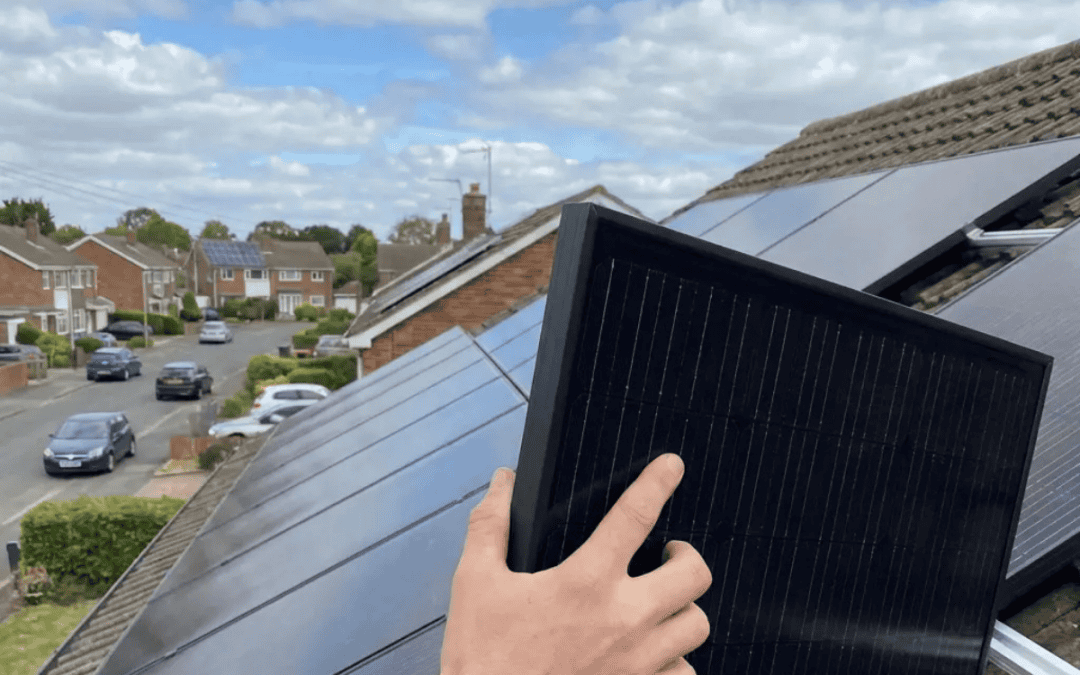
We’re watching something remarkable happen in the UK solar panel market, and most homeowners have no idea.
Premium N-type solar technology—the stuff that was reserved for high-end installations just three years ago—now shows up in budget-tier systems. The same panels that cost £1,250 per kilowatt in 2023 are available today for £820.
This isn’t a sale. It’s commoditization.
And it reveals something deeper about where this market is heading.
The Numbers Tell a Story Most Analysts Miss
Around 1.6 million UK homes now have solar panels installed. That represents a 5,217% increase from just 28,211 installations in 2010.
But here’s what matters more: more than 40% of new houses in England now include solar panels at the build stage.
Solar shifted from an afterthought to a standard feature. The market matured while we were busy debating payback periods.
The April 2022 energy price cap rise accelerated everything. Payback periods dropped from 11.4 years in 2015 to 7-12 years today. The economy transformed overnight.
Typical annual savings now reach £400-£600 on electricity bills for a 4.0 kWp system. Add £80-£170 in Smart Export Guarantee earnings, and you’re looking at £550-£800 per year in total potential savings.
That’s not speculative ROI. That’s real money hitting bank accounts every quarter.
The Zero VAT Window Creates Artificial Urgency (And Real Savings)
The UK’s 0% VAT rate on solar panels saves homeowners approximately £565 on an average system costing £11,307.
This temporary incentive expires March 31, 2027. After that, it reverts to 5% VAT.
We’re seeing installation decisions compressed into a three-year window. The policy introduced in April 2022 applies to all system components—panels, batteries, inverters, and installation labor for residential properties.
But here’s the interesting part: the artificial deadline is driving market education faster than any government campaign could.
Homeowners who might have researched solar casually for years are now getting quotes within weeks. The urgency is manufactured, but the learning curve is real.
N-Type Technology Became the New Baseline
N-type solar cells achieve 26.7% efficiency in laboratory conditions, surpassing P-type cells’ 26.1% record.
That’s not the important part.
What matters for UK homeowners: N-type panels demonstrate degradation rates as low as 0.25% per year compared to 0.50% for traditional P-type cells. They retain 90%+ of original output after 25-30 years.
N-type cells also feature superior temperature coefficients (-0.30%/°C versus -0.50%/°C for P-type). They maintain efficiency better during the summer months—crucial for maximizing output in the UK’s variable climate.
Three years ago, this technology commanded premium pricing. Today, it shows up in mid-tier offerings.
The speed of that transition tells you everything about manufacturing scale and global competition.
Warranty Length Reveals Manufacturer Confidence (And Uncertainty)
Warranties now range from 25 to 40 years across the market.
You might assume longer warranties always indicate better quality. We found something more nuanced.
Extended warranties from established manufacturers reflect confidence. Extended warranties from new entrants reflect marketing strategy.
The difference matters when you’re planning for a 30-40 year lifespan.
A 40-year warranty from a company that’s existed for 15 years carries a different weight than one from a manufacturer with 50 years of operational history. The actuarial risk is fundamentally different.
We’re also seeing warranty terms get more specific. Some manufacturers now explicitly cover degradation rates, not just catastrophic failure. That granularity indicates market maturity.
The Smart Export Guarantee Market Matured Faster Than Expected
SEG tariff rates vary from 4p to 16.5p per kWh depending on the supplier.
The average bundled SEG tariff rose from 5.5p to 13.45p per kWh between 2021 and 2024.
Scottish Power offers the best no-switching-required rate at 12p per kWh. E.ON’s Next Export Exclusive reaches 16.5p per kWh for willing switchers.
This market-driven pricing mechanism proved more lucrative than the old Feed-in Tariff export rates. Households exporting 20-30% or more of their generation benefit significantly from the switch.
But here’s what the data really shows: the market now rewards optimization, not just installation.
You can’t just slap panels on a roof and expect maximum returns. You need to understand export timing, consumption patterns, and tariff structures.
That complexity is driving demand for integrated solar-plus-storage systems.
Battery Integration Transforms the Value Equation
A solar battery enables homeowners to use around 30% more of their solar-generated energy.
That translates to approximately £180 in additional annual savings and a 15% reduction in carbon footprint.
Battery storage costs range from £4,000 to £8,000. The Tesla Powerwall costs approximately £7,995 for an average three-bedroom house capacity.
The economics are straightforward: each kWh produced is nearly three times more valuable when self-consumed (at £0.25 import price) versus exported (at £0.09 export rate).
Storage becomes economically compelling despite extended payback periods.
We’re seeing adoption rates accelerate. The shift isn’t toward solar alone anymore. It’s toward integrated energy systems that maximize self-sufficiency.
UK Climate Optimization Became a Competitive Differentiator
Despite the UK’s famously overcast weather, solar panels work on daylight rather than direct sunlight.
Optimized panels generate 15-25% more energy annually in diffuse light conditions.
Performance in the UK’s climate yields substantial geographic variation. Southern England homes generate approximately 4,200 kWh annually from a 4 kW system versus 3,400 kWh in Scotland—a 24% difference.
That variation significantly impacts ROI calculations and system sizing requirements.
We’re seeing manufacturers develop panels specifically optimized for low-light performance. The UK market is large enough to justify specialized product lines.
This specialization didn’t exist five years ago. It exists now because the market demanded it.
The Absence of UK Manufacturing Reveals Supply Chain Realities
The UK market lacks domestic solar panel manufacturing.
Every panel installed in Britain comes from international supply chains—primarily China, with some European and American manufacturers in the mix.
This creates interesting dynamics.
UK installers become curators rather than sellers. They select from global manufacturers, optimize for local climate conditions, and compete on installation quality rather than product differentiation.
The lack of domestic manufacturing also means UK homeowners benefit from global price competition without tariff protection, inflating costs.
It’s a trade-off. Supply chain resilience suffers, but pricing benefits.
Installer Quality Exceeds Panel Performance as Cost Driver
Installed costs range from £700-£820 per kilowatt for budget-tier systems to £1,195-£1,250 per kilowatt for premium systems.
That’s a significant spread.
But here’s what we found digging into actual installation data: the variance in long-term system performance between a £700 and £1,200 per kilowatt installation often comes down to installer quality more than panel specifications.
A poorly installed premium panel underperforms a well-installed mid-tier panel over 25 years.
Installer accreditation (MCS) and EPVS participation matter more than most homeowners realize. These certifications indicate training, insurance, and accountability.
The market is maturing to the point where installation quality is becoming the primary differentiator.
Solar as Fixed-Cost Replacement Changes the Conversation
We’re seeing a subtle but important reframing in how homeowners think about solar.
The old conversation focused on ROI timelines and payback periods.
The new conversation focuses on energy cost stabilization.
When you install solar, you’re essentially pre-paying for 25-30 years of electricity at today’s rates. Energy prices will fluctuate. Your solar production won’t.
This reframing changes risk assessment.
You’re not betting on solar technology improving. You’re hedging against energy price volatility.
That’s a fundamentally different value proposition, and it’s resonating with homeowners who remember the 2022 price shock.
What This Commoditization Actually Means
The UK solar market reached a tipping point.
Premium technology became accessible at budget prices. Installation quality emerged as the primary differentiator. Battery integration shifted from luxury to standard consideration. Climate optimization became specialized enough to justify dedicated product lines.
The market matured.
And with maturity comes predictability. Homeowners can now make solar decisions with confidence that wasn’t possible five years ago.
The technology works. The economics work. The supply chains work.
What remains is execution—choosing the right system for your specific situation and finding an installer who won’t cut corners.
That’s a much simpler problem than wondering whether solar makes sense at all.
The answer to that question is increasingly obvious. For most UK homeowners with suitable roofs, it does.
The interesting questions now are about optimization, not viability.
That’s what a mature market looks like.