
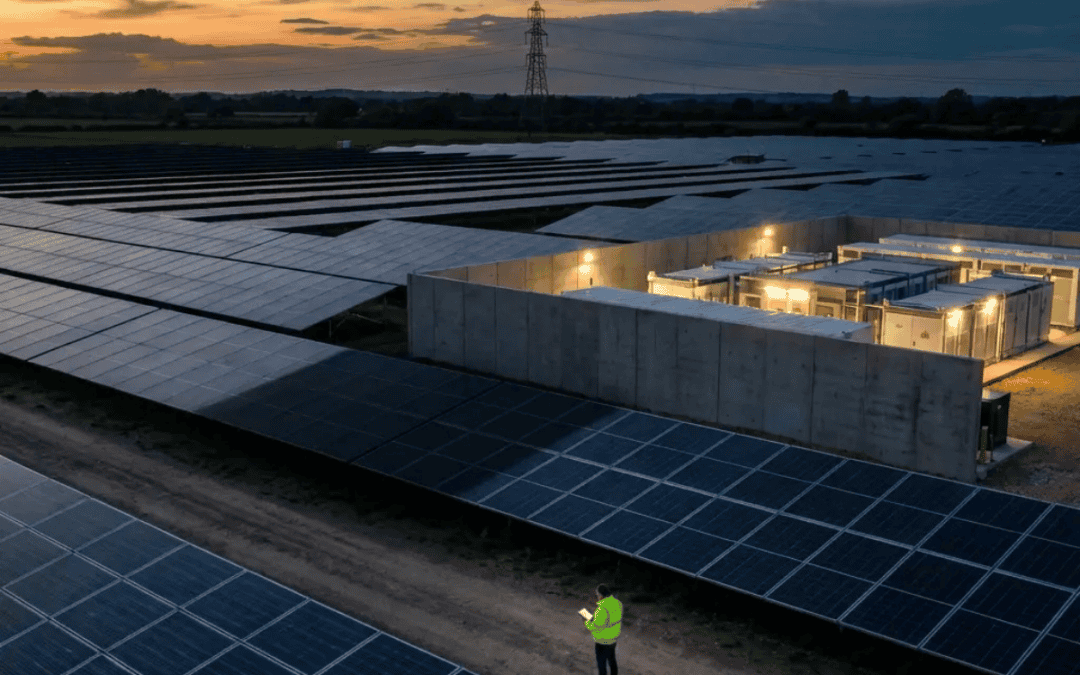
The UK solar market is accelerating toward a wall that other countries have already hit—grid capacity isn’t infinite, but the industry keeps building as if it is.
Constraint payments in the UK nearly tripled between 2020 and 2024-2025, reaching £1.7 billion. Forecasts suggest this could hit between £4 billion and £8 billion by 2030.
Over 5TWh of clean electricity was curtailed across Great Britain and Ireland in just the first half of 2025. That’s enough to power every household in Scotland for six months.
Curtailment is now a structural feature of the UK solar market.
The Math That Changes Everything
When renewable penetration reaches critical mass, wholesale prices during peak output periods collapse. Zero pricing becomes routine. Negative pricing becomes normal.
In Great Britain, only 63% of the wind power that could have been generated actually reached the grid in recent periods. The cost of turning down that other 37% gets passed directly to energy bills. Solar is following the same pattern—curtailment volumes from solar farms increased fourfold year-on-year in 2025.
Ireland switched off around 24GWh of solar in June 2025 alone—nearly seven times more than in June 2024.
The Contracts for Difference Allocation Round 7 results secured 4.9GW of solar capacity across Britain, with 157 solar plants due online by 2029. Every megawatt will hit a grid that’s already struggling to absorb what we’re generating today.
Why Retrofitting Storage Doesn’t Solve the Problem
But retrofit projects face barriers that most developers don’t anticipate until they’re deep into technical assessments.
Many operational solar sites were designed with export-only grid connections. The connection was sized tightly to the generation capacity. Import capability is limited or non-existent. You can’t charge batteries from the grid during low-price periods if your connection agreement doesn’t allow import.
Export caps create another constraint. Even with storage, the combined output of solar and storage may still be limited by your original connection capacity.
Connection agreements often prohibit technology additions without modification processes that can take years. The grid operator needs to reassess system impact, update protection schemes, and potentially upgrade infrastructure.
Physical constraints include land availability around existing substations, inverter compatibility with battery systems, substation capacity to handle bidirectional power flows, and control system integration between solar and storage assets.
Retrofitting can work in selective cases, but it’s complex, expensive, and site-specific. It’s not the scalable solution the industry needs.
The Economics Have Already Shifted
Battery pack prices for stationary storage dropped to $70/kWh in 2025—45% lower than in 2024. This makes stationary storage the lowest-priced segment for the first time in the technology’s commercial history.
The lowest observed prices were $36/kWh for cells and $50/kWh for packs for LFP batteries intended for stationary storage applications.
The cost barrier that made solar-plus-storage prohibitive five years ago no longer exists.
When constraint payments are adding £1.23 to typical household monthly bills, and curtailment is becoming routine, integrated storage isn’t just capturing revenue during high-price periods—it’s avoiding curtailment losses during low-price periods.
The Australian market shows battery revenues increasingly depend on arbitrage and system services rather than power-only strategies. As renewable penetration increases, the value shifts from energy to flexibility.
Co-location Must Start at Development Stage
Designing solar-plus-storage as an integrated system from the outset solves multiple problems.
You optimize grid connections for bidirectional flow from day one. Size your connection for combined output and input. Design a control architecture that treats solar and storage as a unified asset.
You align commercial strategy with market signals. Structure power purchase agreements that value flexibility, not just volume. Position your asset to capture revenue from system services, frequency response, and capacity markets in addition to energy sales.
When negative pricing becomes routine, your asset can respond profitably instead of curtailing at a loss.
The grid connection queue creates additional incentives for integrated design. Under the Technical Limits program, connection offers come with extreme curtailment requirements. Solar Energy UK reports seeing curtailment limits as low as 63%, with some developers told their limit is zero—not a single solar-powered electron allowed to flow into the grid without storage to buffer it.
Grid operators want assets that solve system problems, not assets that create them.
The International Pattern Is Consistent
Every market that has reached high renewable penetration has followed the same progression:
Phase 1: Subsidy-dependent deployment drives rapid capacity growth.
Phase 2: Capacity saturation leads to price collapse during peak renewable output periods.
Phase 3: Curtailment becomes routine as grid infrastructure can’t keep pace with generation capacity.
Phase 4: Flexibility premium emerges—assets that can shift, store, or modulate output command higher values than inflexible baseload generation.
Germany, California, Australia, and Spain have all moved through these phases. The UK is currently in the transition between Phase 2 and Phase 3.
Corporate PPAs Create Demand for Integrated Assets
Businesses seeking decarbonization credentials want a stable, predictable supply without exposure to wholesale market volatility or curtailment risk embedded in their power costs.
Solar-plus-storage delivers firm capacity with renewable credentials. You offer a shaped supply that matches demand profiles instead of intermittent generation that peaks when it’s least valuable.
Well-structured corporate PPAs provide stable revenues that make project financing more attractive. They mitigate downside risk from volatile and negative pricing. They create long-term business relationships instead of transactional commodity sales.
As corporate renewable procurement matures, buyers are shifting from “we bought renewable energy” to “we bought reliable renewable energy that supports grid stability.”
Repowering Creates a Time-Limited Window
The first wave of UK utility-scale solar projects is approaching end-of-life. Over the next decade, operators will face decisions about decommissioning, life extension, or repowering.
Repowering offers strategic opportunities: increase capacity with more efficient panels, upgrade inverters and control systems, and add storage as part of a comprehensive redesign rather than a retrofit.
Capital deployment decisions made in the next five years will determine competitive positioning for the following 20-30 years. Assets that integrate storage during repowering will operate in a fundamentally different market environment than assets that don’t.
What This Means for Your Planning
For new solar projects, co-location with storage should be your default assumption. Design your grid connection, land lease, and commercial strategy around integrated operation from day one.
For existing assets, assess retrofit feasibility now. Understand your connection constraints, land availability, and upgrade costs while you still have time to plan properly.
For financing renewable projects, evaluate flexibility and system integration as core value drivers. Assets designed for a saturated grid environment will maintain value better than assets designed for a capacity-constrained environment.
The transition from solar-only to solar-plus-storage won’t happen instantly, but the timeline is accelerating, and the cost of waiting is increasing.
Grid saturation is creating a two-tier asset class within renewable generation. Assets designed with flexibility from inception will command premium valuations. Inflexible legacy assets will face structural devaluation as market dynamics evolve.
The £1.7 billion in constraint payments represents more than wasted energy—it signals a fundamental market restructure. Capital will flow not toward generation capacity alone, but toward assets that solve system-level problems. The industry that learns this lesson early will capture the premium. The industry that waits will pay for it twice: once in curtailment losses, and again in competitive disadvantage.
Co-location isn’t an enhancement anymore. It’s the baseline for viability in a saturated grid.