
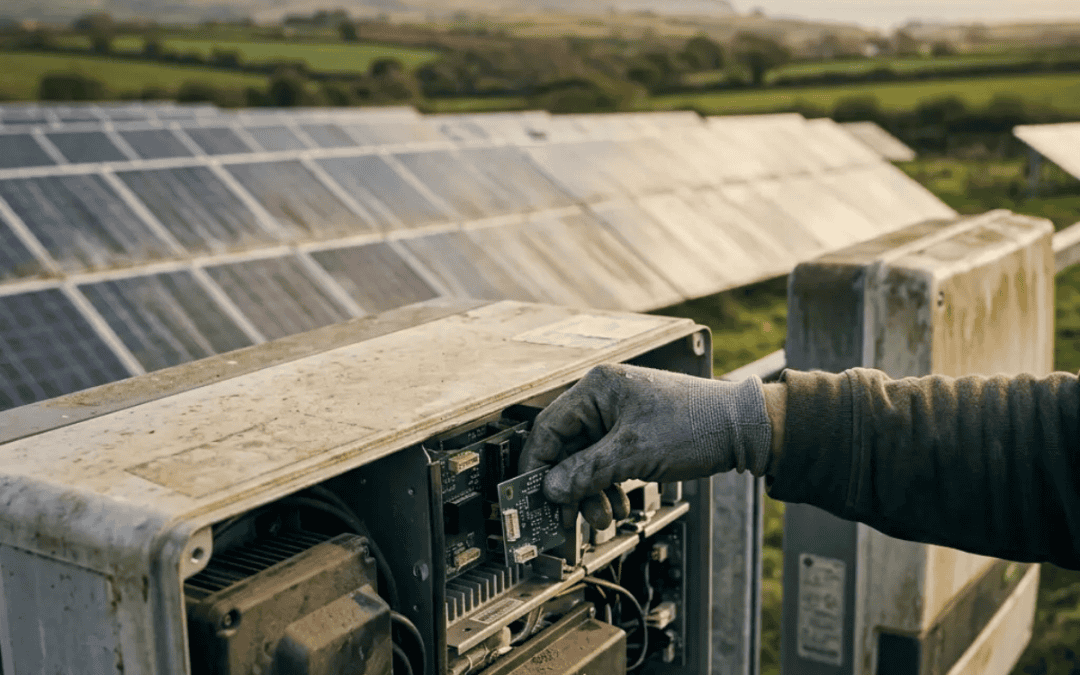
Enviromena repowered 30 MW of solar capacity across Southwest England. Four installations. Component replacements. Warranty fixes. Reliability upgrades.
Combined with 25 MW repowered last summer, they’ve upgraded 60 MW of existing solar assets.
More projects are scheduled for the coming months.
This isn’t news because one company replaced inverters. It’s news because it shows where the solar industry is heading.
The Industry Just Hit Its Maintenance Phase
For the past two decades, solar energy meant one thing: build more capacity. Developers chased land deals, interconnection queues, and power purchase agreements. The game was expanding.
That game is changing.
One million residential solar systems in the U.S. are more than 10 years old. Another 400,000 will hit that milestone annually for the next five years.
The global solar asset management market was valued at $3.8 billion in 2024. By 2033, it’s projected to reach $10.2 billion.
That’s 11.5% annual growth driven by aging infrastructure.
The solar industry is evolving from “build and operate” to “build, maintain, and optimize.” Enviromena’s Southwest England campaign is one example of this transition.
The Component Mismatch Problem
Solar panels are built to last. Most maintain 80 to 90% efficiency after 25 years. They degrade slowly, typically 0.5 to 0.7% per year.
Inverters are different.
These sensitive electronics process the power your panels generate. They fail faster. Most reach the end of life after 10 to 15 years. Some fail sooner.
23 GW of U.S. solar will approach the 15-year inverter benchmark within five years. That’s 4.5 GW of projects needing new inverters every year until 2030.
Those same projects have panels and a balance of plant equipment rated for 35 years.
You see the problem. Your panels are fine. Your inverters are dying. Your revenue is at risk.
For grid-scale projects, this mismatch becomes expensive fast. Accelerated or undetected degradation can mean tens of millions of dollars in missed performance payments.
Enviromena’s focus on warranty-related issues in Southwest England suggests they encountered this exact scenario. Components failed before expected. Performance dropped. Revenue suffered.
The solution? Systematic replacement programs before failures cascade.
When Repowering Makes Economic Sense
Repowering often costs 80% of the total plant value. That sounds like a lot until you compare it to the alternative.
Building a new solar installation from scratch means starting over. You need land. Environmental permits. Grid studies. And the big one: interconnection approval.
Interconnection times for new energy projects now range from 3.8 years in New England to 9.2 years in California. That’s years of zero revenue while you wait in the queue.
Repowering an existing site bypasses most of that. You already have a grid connection. You already have permits. You already have land rights.
The economics shift dramatically. Repowering can cost 50% to 80% less than a new installation, with the primary savings coming from the existing grid interconnection.
You’re not just replacing components. You’re protecting an asset that took years to develop and connect.
For independent power producers like Enviromena, the calculation becomes clear: invest in maintaining existing revenue streams or gamble on new development timelines.
They’re choosing maintenance. So are others.
Geography Matters More Than Expected
Enviromena concentrated their repowering efforts in Southwest England. That geographic clustering raises questions.
Climate and location affect solar panel degradation rates. PV panels installed in cold climate zones, such as the UK, exhibit more hotspots compared to hot tropical zones.
Desert and tropical installations show degradation rates ranging from 1.2% to 1.8%, significantly higher than the industry median.
Southwest England’s climate conditions may accelerate certain degradation patterns. Marine air. Temperature fluctuations. Moisture levels. These factors stress components differently than installations in drier, more stable climates.
This matters for the broader industry.
If regions require earlier intervention, solar performance models need refinement. Financing assumptions need adjustment. Maintenance reserves need recalibration.
The one-size-fits-all approach to solar asset management doesn’t work when geography drives different degradation timelines.
The Warranty Issue Nobody Talks About
Enviromena specifically mentioned addressing “warranty related issues” in their repowering work.
That phrase deserves attention.
During solar’s rapid expansion, manufacturers scaled production aggressively. Quality control sometimes lagged. Component durability varied.
Now those early installations are revealing which manufacturers delivered on their promises and which didn’t.
Warranty claims are complex. Manufacturers may have been acquired, restructured, or gone out of business. Proving failure modes takes time. Getting replacements takes longer.
Independent power producers face a choice: fight warranty battles while revenue drops, or invest in replacements and move forward.
Enviromena chose the latter. They’re prioritizing operational performance over warranty recovery.
This approach reflects industry reality: keeping assets generating revenue matters more than winning component disputes.
Capital Allocation Gets Complicated
Every dollar Enviromena spends repowering existing assets is a dollar they’re not spending on new development.
This trade off defines the next phase of renewable energy growth.
Independent power producers must now split capital between two competing priorities:
Expansion: New projects that add capacity and capture growing renewable energy demand.
Optimization: Existing assets that need investment to maintain performance and protect revenue.
Both are necessary. Both compete for limited capital.
The balance will vary by company strategy, portfolio age, and market conditions. But every player in the sector faces the same fundamental tension.
Enviromena’s 60 MW of repowering represents capacity they’re maintaining rather than building new.
As installations age into their second decade, this capital allocation challenge intensifies.
What This Means for Solar Economics
Solar project financing has traditionally focused on upfront development costs and long term revenue projections.
The repowering wave changes that calculation.
Lifecycle maintenance costs need explicit modeling. Financing structures need to account for mid life capital injections. Return calculations need to incorporate component replacement cycles.
This is maturation, not a problem.
Every infrastructure sector goes through this evolution. Wind power went through it earlier. Natural gas plants have always included maintenance reserves. Solar is just catching up.
The timing and scale are different.
Solar’s explosive growth means a massive wave of installations hitting maintenance age simultaneously. The industry must absorb this transition while continuing to expand capacity.
Companies that planned for this transition will thrive. Those who assumed panels would just keep working without intervention will struggle.
The Secondary Market Emerges
Enviromena’s repowering campaign creates demand for specialized services and components.
A secondary market is forming around solar asset maintenance:
Component manufacturers are developing replacement products specifically designed for repowering projects.
Engineering firms are building expertise in retrofit design and compatibility analysis.
Contractors specialize in component replacement without full site reconstruction.
Asset managers are offering lifecycle optimization services that identify optimal intervention timing.
This ecosystem didn’t exist five years ago. Now it’s essential.
Companies that establish leadership here will capture value as the repowering wave accelerates.
What Happens Next
Enviromena plans additional repowering projects in the coming months. They’re not alone.
Across the industry, operators are evaluating their aging assets. They’re running degradation analyses. They’re modeling replacement scenarios. They’re allocating capital.
The next few years will reveal which companies managed their portfolios with foresight and which played catch up.
For the solar sector overall, this transition represents growth, not decline. The asset management market expanding from $3.8 billion to $10.2 billion means jobs, innovation, and economic activity.
It means solar energy is a permanent infrastructure, not an emerging technology.
Permanent infrastructure requires maintenance. It requires optimization. It requires ongoing investment.
Enviromena’s 60 MW of repowering in Southwest England demonstrates how renewable energy companies will operate in the decades ahead.
Build. Maintain. Optimize. Repeat.
That’s the new playbook.