
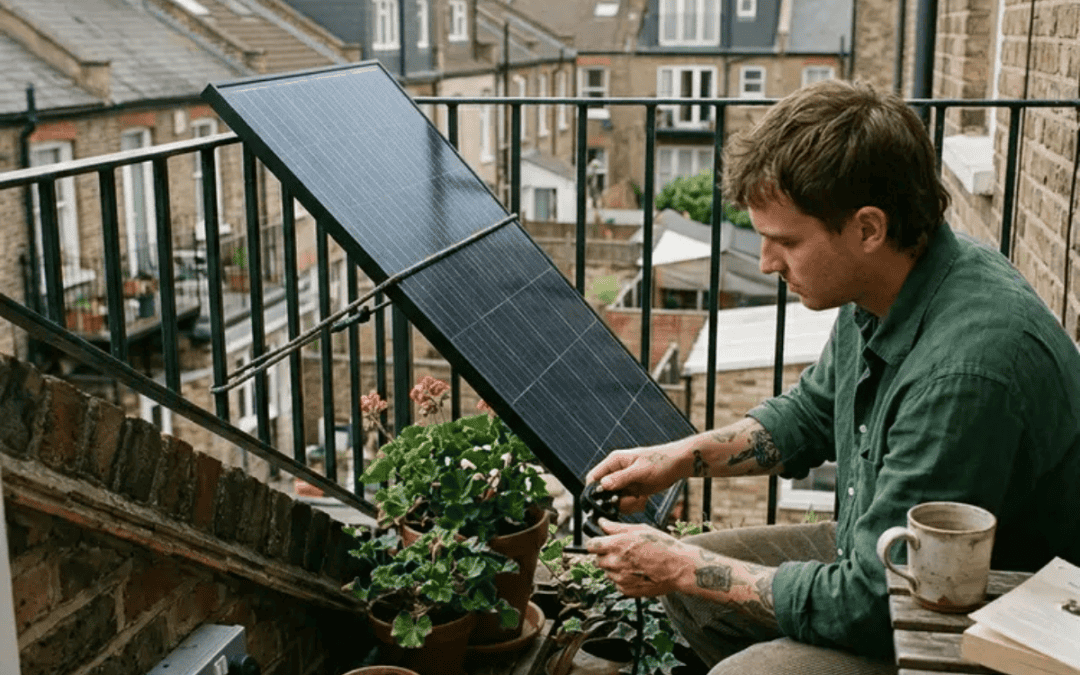
I’ve spent the last few weeks digging into plug-in solar panels for UK households. Not the rooftop installations that require contractors and planning permission. The ones you plug into a wall socket.
The £1,100 savings over 15 years isn’t the surprising part. What surprised me is who gets locked out of those savings—and what’s changing.
According to Carbon Brief’s analysis, a typical UK household saves £1,100 over 15 years with an upfront cost of around £500. That’s a 5-year payback period for a device that generates 400 kilowatt hours annually, enough to cover 15% of typical household demand.
This isn’t just about the money. It’s about who gets access.
The Renter Problem Nobody Talks About
One-third of UK households rent. They don’t own their roofs. They can’t install traditional solar panels.
Renewable energy has been a homeowner’s game. If you rent, you’re locked out. If you live in an apartment, you’re locked out. If you don’t have £10,000 for a rooftop installation, you’re locked out.
Plug-in solar changes that equation.
You buy a panel. You mount it on your balcony or in your garden. You plug it into a standard outlet. You start generating electricity.
No contractor. No planning permission. No landlord approval in most cases.
The UK Regulatory Shift That Changes Everything
Until March 2026, plug-in solar panels were effectively illegal in the UK.
BS 7671 wiring regulations prohibit connecting generation equipment to standard sockets. The concern was backfeed current and circuit overload. Technically valid engineering questions, but based on theoretical risk rather than accident data.
On March 16, 2026, Energy Secretary Ed Miliband announced the government would legalize plug-in solar. BS 7671 Amendment 4 was published on April 15, 2026. The BSI product standard is expected by July 2026.
The new framework permits systems under 800W. Enough to generate 400 kilowatt hours annually without an electrician installation or planning permission. Users must notify their Distribution Network Operator through the G98 process, but the barrier drops from “requires professional installation” to “fill out an online form.”
This regulatory shift matters because it removes the primary obstacle preventing UK adoption. The technology worked in Germany. The economics worked across Europe. What the UK lacked was a legal framework.
That changed in March.
Major retailers are already positioning for market entry. Lidl and John Lewis have announced plans to stock certified plug-in solar kits. Amazon UK carries imported systems, though most don’t yet meet the new BSI certification standards expected in July.
The current market price ranges from £600 to £1,000 for an 800W kit. Not the £500 figure in Carbon Brief’s analysis, which likely assumed cost compression as the market matures. Early adopters will pay a premium. Mass market pricing follows certification and retail competition.
What Happens When You Remove Barriers: The Germany Case Study
The UK’s March 2026 regulatory shift didn’t emerge in a vacuum. Germany ran the experiment first.
As of June 2025, Germany has over 1 million registered plug-in solar systems. Some estimates put the actual number closer to 4 million units in use. Between January and April 2025 alone, around 135,000 new systems went live, adding 53.4 MW of distributed solar capacity.
That’s what happens when technology becomes accessible.
The German government simplified it: streamlined regulations, clear installation guidelines, and removal of bureaucratic friction. People responded by installing panels at a rate that surprised even optimistic forecasters.
The same pattern is emerging in the United States. As of February 2026, lawmakers in 28 states have introduced legislation to permit plug-in solar systems. This isn’t partisan—both Democratic and Republican states are moving forward.
Rising electricity costs drive interest across political lines. When your monthly bill climbs, ideology takes a back seat.
The Macro Impact of Micro Generation
Individual action connects to national energy security.
In March 2026, record wind and solar generated 11 terawatt hours of electricity in the UK. This avoided gas generation that would have required importing around 21 terawatt hours of gas. Roughly 18 fully loaded tankers of liquified natural gas. At current prices, that would have cost around £1 billion.
One month. One billion pounds.
Plug-in solar panels alone didn’t create that impact. But when you aggregate millions of small-scale generators across households, the cumulative effect reshapes national energy infrastructure.
Every 400 kilowatt hours generated by a plug-in panel is 400 kilowatt hours that don’t come from the grid. Multiply that across hundreds of thousands of households, and you see meaningful reductions in import dependency.
This is the hidden value proposition: micro-level adoption creates macro-level resilience.
The regulatory change creates access. But does the financial case hold up under scrutiny?
The Economics That Actually Matter
Let’s address the obvious objection. The £1,100 figure breaks down to £73 per year over 15 years.
That’s two takeaway coffees a month. Not exactly transformative wealth.
But here’s the double standard: People apply different criteria to sustainable technology than to other purchases. Nobody expects their refrigerator to generate ROI. Nobody demands their washing machine pay for itself in 2 years.
With renewable energy, we impose financial hurdles that we apply nowhere else, then wonder why adoption lags.
The European market data shows payback periods ranging from 2 to 6 years, depending on system size, local solar irradiation, and energy prices. UK households fall within that range at 5 years.
After payback, you generate free electricity for the remaining 10 years of the system’s life. That’s where the actual value sits, but most analyses bury this in fine print.
And unlike your washing machine, this appliance also reduces your carbon footprint and increases grid resilience. The ROI calculation ignores half the returns.
Consider a typical scenario: A renter in Manchester with a south-facing balcony installs an 800W system for £750. At current Ofgem rates (approximately 24p per kilowatt hour), generating 400 kilowatt hours annually saves £96 per year. Payback occurs in year 8. Years 9 through 15 generate £672 in savings. Net profit after recovering the initial investment.
That’s the base case. If electricity prices rise (historically likely), payback accelerates. If the system lasts beyond 15 years (many do), the value compounds further.
Why Complexity Kills Adoption Faster Than Cost
The economics justify rooftop solar for millions of UK homeowners. Yet adoption remains a fraction of what the financial case would suggest.
The problem isn’t economics. It’s friction.
Traditional solar installation requires:
- Homeownership
- Significant upfront capital (£5,000-£15,000)
- Contractor coordination
- Planning permission in some cases
- Roof structural assessment
- Electrical system modifications
- Long-term commitment to a single property
Each represents a decision point where potential adopters drop out.
Plug-in solar eliminates most of these barriers. The “plug-in” aspect isn’t just a feature. It’s the value proposition. You reduce the decision from a major home improvement project to an appliance purchase.
Complexity kills adoption faster than cost.
This pattern repeats across technology categories. The breakthrough isn’t when something becomes 10% better or 20% cheaper. It’s when it becomes simple enough that the average person can implement it without expert help.
The Grid Management Challenge Nobody’s Solving Yet
The rapid adoption trajectory creates a concern: grid infrastructure wasn’t designed for millions of distributed generators.
Traditional energy systems operate on a centralized model. Large power plants generate electricity. The grid distributes it. Consumption happens at endpoints.
Plug-in solar inverters that model. Endpoints become generators. Energy flows bidirectionally. Demand becomes variable based on local generation.
This creates grid management complexity that the current infrastructure isn’t equipped to handle at scale.
This isn’t a reason to slow adoption. We need parallel investment in smart grid technology, load balancing systems, and distributed energy management platforms.
The technology exists. The implementation lags behind adoption curves.
What the Policy Environment Reveals
Regulatory developments across markets show a clear pattern: governments are moving from obstruction to facilitation.
Virginia legalized plug-in balcony solar for apartment dwellers, joining jurisdictions that recognize the equity implications of energy access. When 44 million American households rent their homes, excluding them from renewable energy participation creates a two-tier system.
The UK faces similar dynamics, with renters comprising one-third of households.
Policy changes signal market maturity. When regulators remove barriers rather than create them, the technology has crossed from experimental to viable.
Building codes and rental regulations will evolve. If plug-in solar becomes economically compelling at scale, landlords will face pressure to accommodate installations. Some will resist. Others will see differentiation opportunities.
The market will sort this out faster than regulation will.
Why Mainstream Retail Matters More Than You Think
When Lidl and John Lewis stock a product category, it signals something beyond retail availability.
Early-stage technology lives in specialty retailers. High prices. Limited selection. Customer service staff who don’t understand the product.
Mainstream retail entry means:
- Manufacturing has achieved scale efficiency
- Component standardization has occurred
- Distribution channels exist
- Quality control processes are established
- Warranty and support infrastructure is in place
This infrastructure enables mass adoption. The technology itself is simple. The ecosystem around it determines whether it scales.
Three Signals That Will Determine UK Adoption Rates
The regulatory framework is set. The economics are established. What remains uncertain is whether the UK follows Germany’s mass adoption trajectory or settles into slow incremental growth.
I’m tracking three indicators:
Regulatory momentum: How many additional jurisdictions remove installation barriers. The 28 US states with pending legislation represent a significant policy shift. If half pass, it creates momentum that’s hard to reverse.
Utility response: How energy companies react to distributed generation at scale. Some will fight it. Others will adapt their business models. The winners will manage distributed resources rather than maintain centralized control.
Grid investment: Whether infrastructure investment keeps pace with adoption. This is the bottleneck that could limit growth.
The £1,100 savings figure establishes economic viability. But the real story is about access, equity, and system-level transformation.
When renewable energy stops being a homeowner’s privilege and becomes a renter’s option, the adoption curve changes.
The UK data shows more than cost savings. It shows a shift in who gets to participate in the energy transition.
The numbers show it works. The policy changes show it’s happening. The German adoption curve shows what’s possible.
The UK has a choice: follow Germany’s trajectory and democratize renewable energy, or maintain a system where only homeowners participate in the energy transition.
The technology is proven. The economics work. The policy barriers are political choices, not technical constraints.
What happens next depends on whether renters get the same energy options as homeowners—or whether we keep pretending a two-tier system serves anyone’s interests.